
If you’ve worked in care for any length of time, you’ve probably sat through your share of training days that didn’t really land. Slides, a handout, maybe a quiz at the end. Useful in a technical sense, forgettable in every other sense. A few weeks later, most of it has evaporated.
We built our approach to immersive dementia training around a different question: not “what do we need people to know,” but “what do we need people to understand, in their gut, so it actually changes how they behave with someone in front of them.”
Information Versus Understanding
There’s an important gap between the two. Information is what you’d find in a textbook: dementia affects memory, causes confusion, can change personality and behaviour over time. All true, all useful to know. But understanding is different. Understanding is grasping why a person living with dementia might resist having their shoes put on, or why a simple request like “just sit down for a minute” can feel, to them, like being cornered by a stranger.
You don’t get to that kind of understanding by reading about it. You get closer to it by experiencing, even in a limited and simulated way, some of the sensory and physical disorientation that can come with the condition. That’s the gap genuine dementia care training for carers is designed to close, and it’s a gap that a slide deck simply can’t reach on its own.
What Happens in the Room
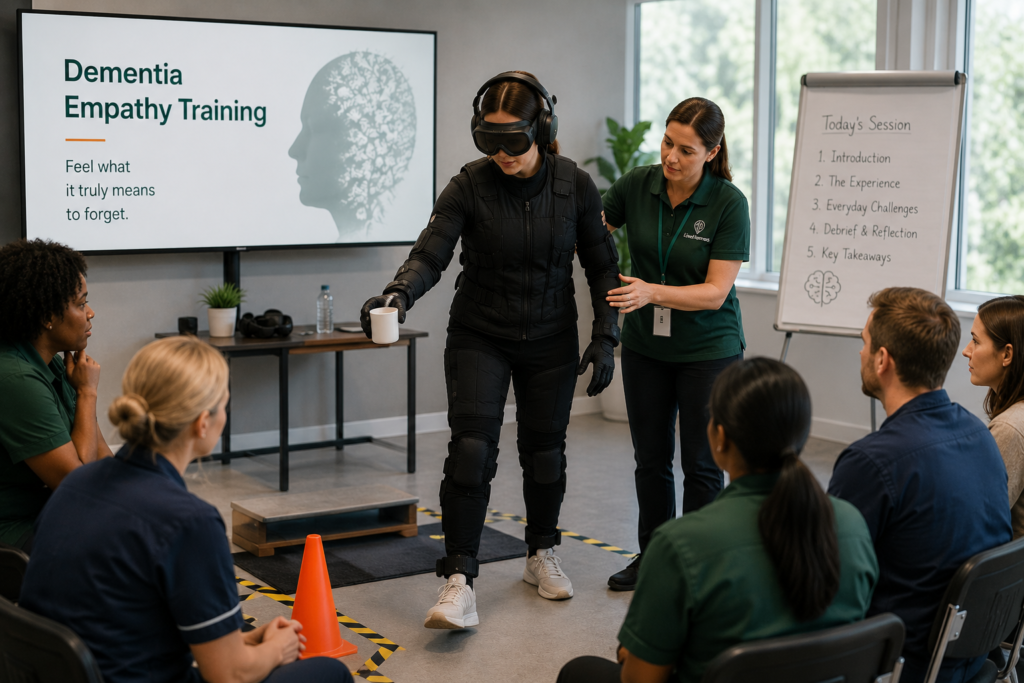
Participants take part in a series of tasks while wearing equipment that recreates specific effects: reduced dexterity, restricted or distorted vision, and disorientating sound. The tasks themselves are ordinary. Pour a drink. Sort some posts. Get dressed. What’s not ordinary is how difficult those tasks suddenly become, and how quickly frustration, anxiety, or a sense of helplessness can creep in.
Afterwards, we talk it through as a group. This part matters as much as the exercise itself. People need space to unpack what they felt and connect it back to the residents or clients they support every day. That’s usually where the real learning happens, in the conversation after the discomfort, not during it.
This structure is what separates effective dementia awareness training from a session that simply informs. Awareness built on lived, felt experience translates far more reliably into changed behaviour than awareness built on facts alone.
Why This Sticks When Other Training Doesn’t
Training that’s purely informational asks people to remember facts. Training built around genuine, felt experience asks people to remember a feeling, and feelings tend to be stickier than facts. Months later, we still hear from teams who tell us they think back to “that training day” when they’re supporting someone who seems confused or agitated. That’s the kind of long-term shift that’s hard to achieve with a slideshow, however well designed.
Supporting Person-Centred Dementia Care
None of this works in isolation. Immersive sessions are most powerful when they feed directly into how a team already thinks about person-centred dementia care seeing the individual first, and their condition second. Once a carer has genuinely felt a fraction of the disorientation dementia can cause, person-centred principles stop being an abstract policy point and start being common sense. Explaining before touching. Slowing down before a task. Reading agitation as communication rather than defiance. These behaviours become instinctive rather than instructed.
Where This Fits Alongside Other Training
For care providers thinking about how to genuinely improve dementia care standards, rather than simply satisfy a training requirement, this is worth serious consideration. It won’t replace clinical training, supervision, or care planning. It complements them, by giving your team a different kind of knowledge: the kind you carry with you, not the kind you file away.
Providers evaluating their current approach to immersive dementia training often find the biggest gains aren’t in what staff can recite afterwards, but in what they instinctively do differently on shift the following week: pausing before a task, explaining more, rushing less. That’s a harder outcome to measure than a certificate, but it’s the one that actually matters to the people being cared for.
If your team’s last dementia training was purely classroom-based, it may be worth asking what would shift if the next session asked people to feel it, not just hear about it. The teams who make that switch tend not to go back.




