
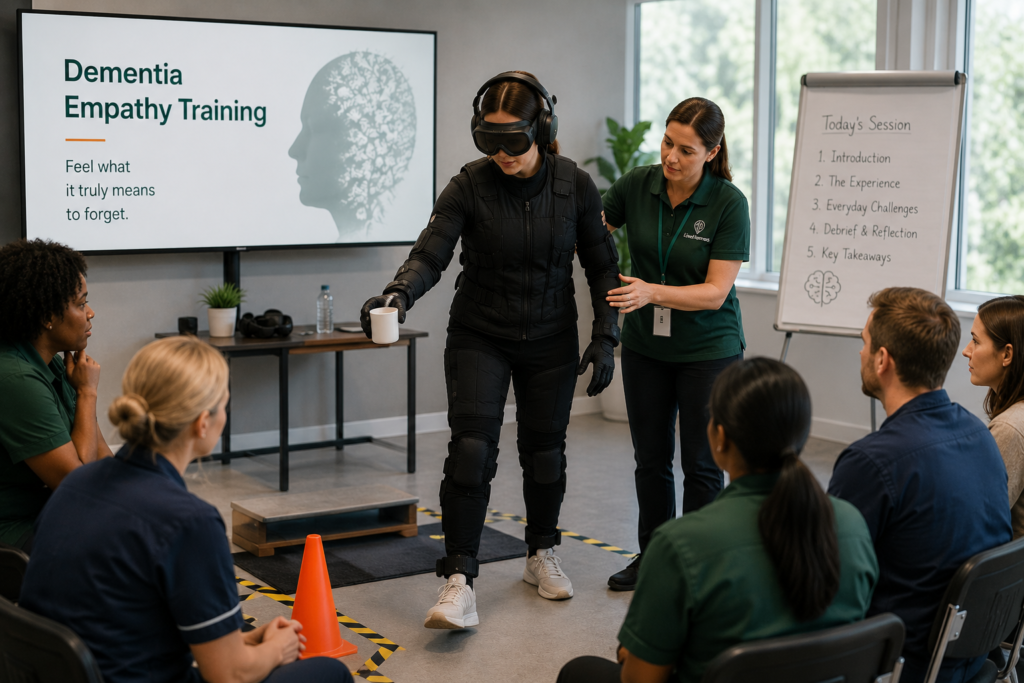
There’s a moment that comes up again and again when people talk about our dementia training for care staff days. It’s usually about twenty minutes in, when the gloves come off, the goggles come off, and someone sits down a bit heavier than they meant to. They go quiet for a second. Then they say something like, “I had no idea it was like that.”
That reaction is the whole point.
We can talk about dementia in a classroom for hours. We can hand out leaflets on empathy, run through the stages, list the symptoms, explain the science of how the brain changes. All of that has its place. But there’s a difference between knowing something and feeling it, and that difference matters enormously when the people you’re caring for can’t always tell you what they’re experiencing.
Why Reading About It Isn’t Enough
Most of us think we understand what it might be like to live with dementia. We picture forgetfulness, maybe some confusion, perhaps a bit of repetition in conversation. What we don’t picture, because it’s hard to picture from the outside, is what it feels like when your hands won’t quite do what your brain is asking of them. Or when background noise stops being background and becomes an overwhelming wall of sound. Or when the everyday task of buttoning a shirt turns into something that takes real concentration and still doesn’t go right.
This is exactly the gap that dementia simulation training is designed to close. Our immersive sessions are built around simulating some of these experiences directly, using specialist equipment that recreates the physical and sensory effects associated with dementia. People wear gloves that dull sensation in their fingers. They put on glasses that distort vision. They try to complete ordinary tasks while wearing headphones playing disorientating layered sound. It sounds almost simple when it’s written down like that. In the room, it rarely feels simple at all.
The Shift We See
What changes afterwards isn’t usually dramatic on the surface. Nobody leaves the session as a different person. But something does shift in how people talk about the residents or clients they support. The frustration in a resident who can’t get their cardigan on suddenly reads differently. The repeated question isn’t just repetition anymore, it’s a genuine, fresh confusion each time it’s asked. Patience becomes less of an effort and more of an instinct, because it’s rooted in something the carer has actually felt, even in a small, simulated way.
This kind of shift is really what good empathy training for carers is aiming for: not a script to follow, but a different starting point for every interaction.
We hear from managers that this shows up in day-to-day practice too. Slower, calmer interactions. More explanation given before physical contact. Less rushing through personal care tasks that, from the other side, can feel intrusive or frightening when someone doesn’t fully understand what’s happening or why.
Training That Sits Alongside the Rest
This kind of experience isn’t meant to replace clinical knowledge or care planning. It sits alongside it, filling in a gap that’s genuinely hard to fill any other way. You can teach someone the facts about dementia in an afternoon. Helping them feel, even briefly, what it might be like to live with it tends to stay with people rather longer.
For teams looking into dementia awareness training care homes can rely on long after the session ends, the format matters as much as the content. A one-off lecture rarely produces lasting behavioural change. A session that puts people, briefly and safely, into someone else’s experience tends to stick in a way that facts on a slide never quite manage.
If you’re putting together training for a team who support people living with dementia, it’s worth thinking about what kind of learning will actually change behaviour on the floor, not just tick a box on a certificate. In our experience, the sessions people remember months later are the ones that made them feel something, not just the ones that gave them information.
Why This Matters Beyond the Training Room
The impact of this approach extends well past the training day itself. Care teams who’ve been through genuine dementia training for care staff report fewer moments of friction during personal care, better rapport with residents who struggle to communicate, and a workplace culture where slowing down is seen as good practice rather than inefficiency. That’s a meaningful return on a single afternoon’s investment.
We run these sessions for care teams who want exactly that: a lasting shift in understanding, not just an afternoon out of the office. If your last dementia training felt more like a lecture than an experience, it’s worth asking what would change if the next one made people feel it instead of simply telling them about it.




